Since 2 August 2026, the EU requires people to be told when they are talking to an AI. For most businesses this is less work than feared. You just need to know what is actually meant.
The transparency obligations in Article 50 of the EU AI Act have been binding since the start of August. If you run a chatbot on your website, this concerns you directly.
The good news first: this is one sentence in the right place, not a project. The less good news: a note buried in your terms and conditions is explicitly not enough.
You did nothing. That is exactly how it should be.
If you use ServasBot, your chatbot carried its disclosure on the day the rules took effect. No update, no new embed code, no instructions we had to send you.
That comes down to how ServasBot is delivered: the code lives with us, not inside your website. You embedded a single line once, and that line always pulls the current version. The Messenger integration runs on our servers anyway. Whatever we improve is live for you immediately.
This is where software as a service has the edge on regulatory topics. If the requirements change tomorrow, we follow. And you hear it from us, not from your lawyer.
What this is actually about
Article 50 covers four cases. For a restaurant, hotel or trade business, two of them are realistic:
- Interactive AI. Anyone writing to your chatbot must learn that an AI is answering. At the latest at the start of the conversation, clearly recognisable.
- Deepfakes and AI images. Realistic-looking image, audio or video content that you publish must be marked as artificially generated. Regardless of company size.
The other two probably do not apply to you. And that is precisely where a lot of guidance creates panic that is not warranted.
What is not meant
Not every AI-written text needs a label. The obligation applies to text published to inform the public about matters of public interest, meaning political, social and economic topics. Your room descriptions, your menu copy, your promotional newsletter do not fall under it. And even where the obligation does apply, it falls away if a person reviews the text before publication and takes responsibility for it.
Internal use is not affected. If you use AI to calculate quotes or draft staff rotas and publish none of it, that triggers no disclosure duty under Article 50.
There is no small-business exemption. The AI Act does provide relief for small companies in several places, on documentation and fees for instance. That does not extend to the transparency obligations in Article 50. If you run a chatbot, you have to disclose it, no matter how small the business.
The rest of the regulation is not in force yet. Anyone writing that the AI Act now applies in full is cutting corners. The comprehensive obligations for high-risk AI were pushed back by the Digital Omnibus to December 2027 and August 2028 respectively. High-risk means systems for things like candidate screening, creditworthiness assessment or risk assessment in life and health insurance. What decides this is the purpose, not the industry: a chatbot answering questions about products, processes and opening hours is not a high-risk system, not even at an insurer. One that helps decide on terms or job applications would be. In that case additional obligations apply from December 2027, and they fall on whoever puts the system to that use.
Does this apply to me if I am not based in the EU?
Probably yes. The regulation does not hinge on where your company is based, but on whether the output of the AI system is used in the EU. A Swiss hotel with guests from Germany and Austria is almost always covered. Switzerland itself has not adopted the regulation; for the EU market it applies regardless.
What a clean disclosure looks like
The regulation prescribes no wording and no symbol. It sets out what has to be communicated, and how. Article 50(1) requires that people are informed “that they are interacting with an AI system”. Paragraph 5 adds: “at the latest at the time of the first interaction, in a clear and distinguishable manner”.
On 20 July 2026 the European Commission adopted the final guidelines on this, and they get pleasingly concrete:
- “Clear” means perceivable and understandable without legal training, including for people with disabilities.
- “Distinguishable” means recognisable as separate from other content. A sentence that disappears into your welcome message does not qualify. Buried in terms and conditions, manuals or collapsible menus: explicitly not sufficient.
- “Timely” means at the latest at the first interaction. And the duty applies towards every individual person, not once per system.
The recommended approach is a combination: a permanently visible label plus a notice at the start of the conversation. A one-off, clearly visible message is enough in most cases. So it may be dismissed.
Literally what the law asks for
That is exactly what ServasBot implements: a permanent “AI assistant” label in the header of the chat window, and the note “You are chatting with an artificial intelligence.” at the start of every conversation, clearly set apart from your own welcome message.
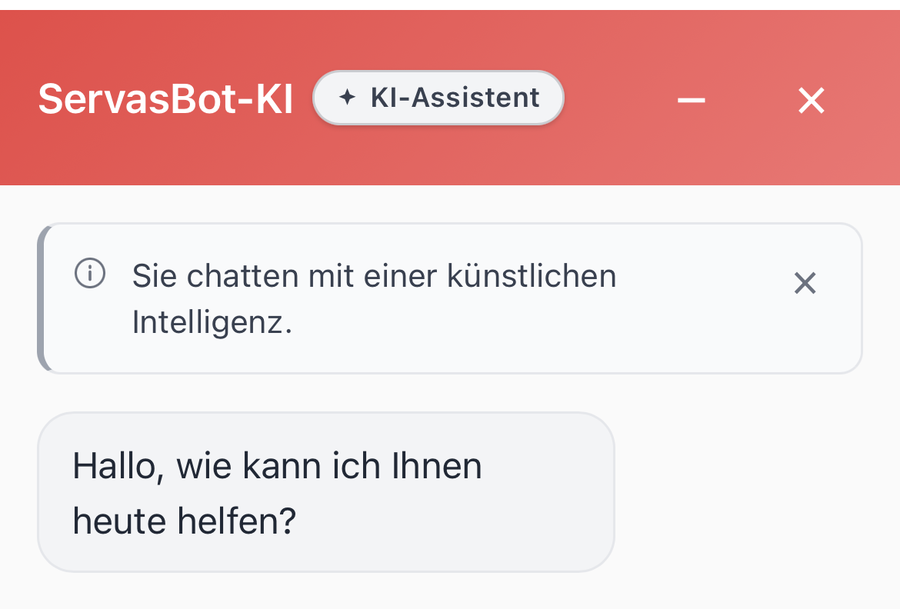
Three things mattered to us here:
- There is nothing for you to configure. No checkbox, no field in the setup wizard, no retrofitting for existing chatbots.
- It cannot be switched off by accident. The disclosure does not hang on any setting someone could delete or overlook. That is deliberate: the duty falls on the provider of the AI system, not on you as the operator. So we solve it in the product instead of pushing it onto your to-do list.
- Your welcome message stays your welcome message. The mandatory notice sits separately above it and does not touch your text.
The disclosure follows your visitors' browser language, not your location. A Carinthian hotel with Italian guests automatically shows the Italian notice; a German online shop with Dutch customers shows the Dutch one. Eight languages today, more to follow. And those will be live for you the moment we add them.
This is implemented on the website and in Facebook Messenger, accessibility included: screen readers read the notice out, and the contrast has been checked. Full details on disclosure and data protection are on the features page and in our FAQ.
Your checklist
ServasBot handles this for you
- A notice in the chat that an AI is answering
- A permanent label in the chat window
- Automatically in the visitor's language
- On the website and in Facebook Messenger
- Implemented accessibly
- For existing and new chatbots, with nothing to do on your side
You need to check this yourself
- AI images and videos you publish: mark them as AI-generated. This covers social media, landing pages and advertising material.
- Voice assistants or phone bots from other providers: do they disclose themselves?
- Other chat channels that do not run through ServasBot: WhatsApp, Instagram direct messages, a second widget on a landing page.
- Who signs off AI content in your business? A named person who reviews texts before publication makes the disclosure duty for text moot. Writing that down internally takes ten minutes.
- Automated newsletters or blog posts that go out without human review: either introduce review or add a label.
- Your privacy policy should mention that an AI system is used in customer contact. Not Article 50, but it belongs to the same tidy-up.
And if you are unsure
Your chatbot's disclosure is done. Everything else depends on what else you do with AI. And that looks different for a hotel than for an agency.
If you like, we can go through it together. Half an hour is usually enough to work out what actually applies to you.
This article is not legal advice. It describes how we implemented the chatbot disclosure duty in ServasBot and what we consider relevant for small businesses. For an assessment of your specific situation, please consult your legal advisor.