Yes, there are AI chatbots built specifically for hotel service and guest care. They run as a digital concierge on a tablet in the room or via a QR code on the guest's phone. They answer standard questions around the clock and take the load off your front desk. This article shows how an AI chatbot is put to practical use in hotels, guesthouses and campsites.
The problem: your front desk answers the same questions 100 times over
Every hotel front desk fields the same guest questions day after day. When is breakfast? What is the Wi-Fi password? Where is the pool? Which hike would you recommend? How do I get to the station? In high season these standard questions quickly add up to 50 to 100 a day.
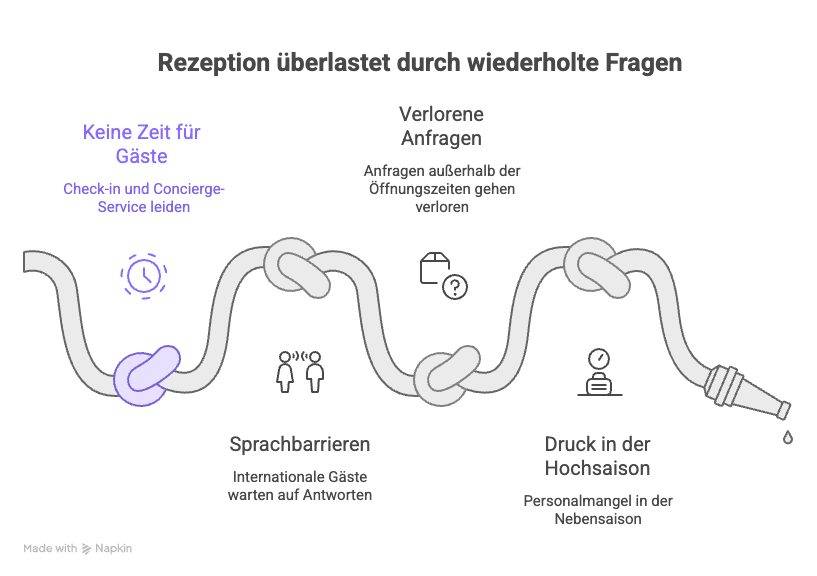
The consequences for your business:
- Front desk staff have no time for check-in, concierge service and personal conversations.
- International guests wait for answers in their own language, which not every staff member speaks.
- Enquiries outside front-desk hours get lost or sit unread in a spam folder.
- In high season the pressure escalates; in low season there is not enough staff for round-the-clock availability.
What guests actually ask
If you log enquiries at your front desk for a week, you will find that around 80% of the questions repeat. The typical concerns at a hotel or guesthouse:
- "When is breakfast and dinner served?" (meals, half board)
- "What is the Wi-Fi password?" (in-room technology)
- "What time is check-out?" (check-out times, late departure)
- "Where is the pool, the sauna, the gym?" (wellness and orientation)
- "What can I do in the area today?" (day-trip tips, hiking trails, sights)
- "How do I get to the station, the airport, into town?" (arrival and transfer)
- "Are dogs allowed?" (house rules, childcare, allergies)
An AI chatbot can answer all of these questions instantly, often better than a stressed staff member in high season. For special cases such as complaints or booking changes, it forwards the matter to the front desk in a structured way.
Three ways the digital concierge reaches the guest
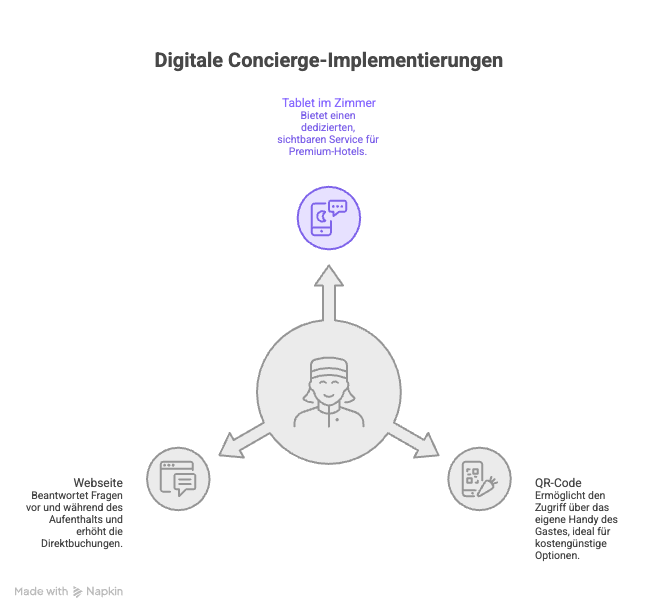
The core advantage of an AI chatbot in tourism: it is exactly where the guest happens to be. Three implementation options have proven themselves.
1. Tablet in the room
A tablet with the chatbot permanently loaded sits on the nightstand or desk. The guest types a question and gets an instant answer. Works without a smartphone and without installing an app. Ideal for 4- and 5-star hotels that want to show a visible premium service.
2. QR code on the guest's own phone
A QR code in the room, on the menu, at reception or in the lobby opens the chat in the guest's browser when scanned. No app download needed, no sign-up. The guest uses their own phone in a familiar environment. This option is particularly affordable and flexible, and suits guesthouses, holiday apartments and campsites.
3. Website before and during the stay
On your hotel website, the chatbot answers questions even before booking. Availability, arrival, house rules, dog surcharge: all of this gets clarified before the guest even calls or writes an email. That reduces the load on your phone lines and increases your direct-booking rate, because fewer guests go via Booking.com.
Which languages can a hotel chatbot handle?
ServasBot uses Mistral (default) or, optionally, OpenAI ChatGPT as the underlying language model. Both models natively understand a wide range of European and non-European languages. The bot detects the guest's language automatically and replies in it: if an Italian guest writes in Italian, it answers in Italian; if the next guest writes in Czech, it answers in Czech.
In the standard tourism package, we highlight 5 languages in particular: German, English, Italian, Dutch and Slovenian. These are the most common guest languages in Austria, especially in the tourism regions of Carinthia, Styria and Salzburg. Other languages are technically possible at any time. If a hotel receives many Czech, Hungarian or French guests, that can be covered without additional development.
Three scenarios from practice
3-star lakeside hotel: taking the load off the front desk in high season
A family hotel with 40 rooms on Lake Wörthersee. In the summer high season the front desk is staffed from 7am to 10pm, but permanently overloaded. Things back up especially between 8 and 11am (check-out, breakfast queries) and between 3 and 7pm (check-in, dinner reservations).
Before: Guests wait 5 to 10 minutes at the front desk just to ask whether the sauna is open today. Regulars no longer feel personally looked after. The receptionist cannot manage to give new guests local tips.
With the digital concierge: A tablet in the room plus QR codes in the lobby and at the breakfast buffet. The bot answers standard questions (sauna hours, breakfast until when, hiking tips) instantly. The front desk focuses on check-in, personal matters and complaints. Regulars notice the difference.
Guesthouse with self-check-in: reachable without a 24-hour front desk
A 12-room guesthouse in a ski region. The owner has no night reception. Anyone arriving after 8pm collects the key from a coded key safe. The problem: guests have questions but can no longer find anyone.
Before: Late arrivals lead to helpless calls to the owner's private number. "Where do I find the key?", "How does the heating work?", "Is there Wi-Fi?" Three to five such calls a week, often after 10pm.
With the digital concierge: A weatherproof sign with a QR code hangs in the entrance area. The guest scans it with their phone, lands straight in the chat and gets answers on the key-safe code, house rules, Wi-Fi password and breakfast time. Even at 11pm. The owner sleeps through the night.
Campsite with international guests: multilingual with no extra effort
A campsite on Lake Faak with 200 pitches. The main season brings guests from the Netherlands, Italy, Germany and the Czech Republic. The core staff speak German and English; the rest of the languages are a gap.
Before: Dutch guests ask about pitch size at reception and get English answers they only half understand. Italian guests read the German house rules and miss the dog policy. Disputes on the pitches arise from language barriers.
With the digital concierge: A tablet at reception plus QR code stickers on the sanitary buildings. The Dutch guest asks about the power hook-up in Dutch, the Italian guest asks about the dog policy in Italian. Both get the right answer in their own language. Staff are left with only the special cases.
Tablet, QR code or website: what suits which business?
| Business type | Tablet in the room | QR code on the phone | Website upfront |
|---|---|---|---|
| 4- to 5-star hotel | Recommended | Complementary (lobby, spa) | Yes |
| 3-star family hotel | Optional | Recommended | Yes |
| Guesthouse, B&B | Rarely needed | Ideal | Yes |
| Holiday apartment | No | Ideal (digital house manual) | Yes |
| Campsite, glamping | At reception | Recommended | Yes |
When an AI phone assistant makes sense as well
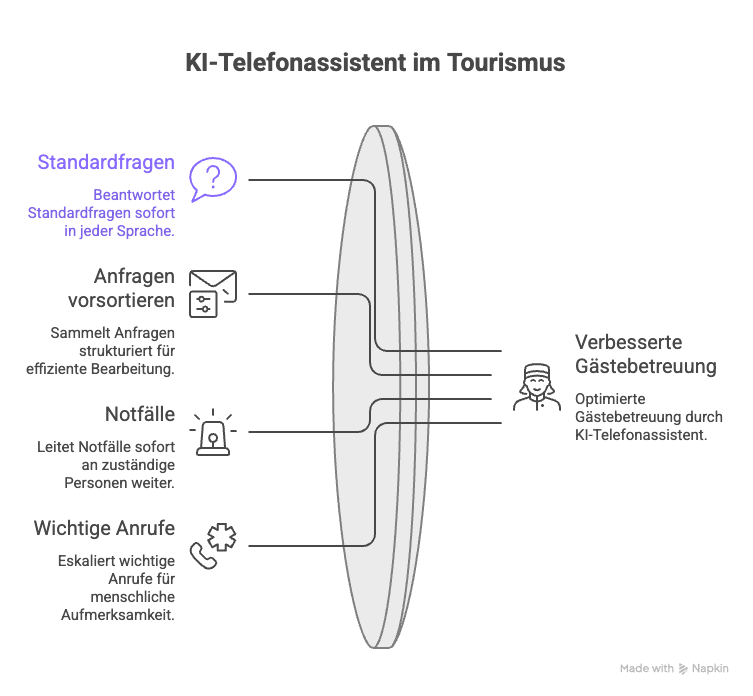
An AI phone assistant is especially valuable in tourism when the front desk is not staffed around the clock. Outside opening hours, in low season, at weekends or at night: callers today often end up in voicemail and never get called back. The phone assistant picks up these calls and makes sure no enquiry gets lost.
Here is what that looks like in practice:
- Standard questions get answered even at night. Availability, prices, breakfast times, arrival: the assistant gives an immediate answer, in the caller's language.
- Enquiries are collected and pre-sorted. Anyone wanting a reservation or describing a request has their details captured in a structured way. You get a sorted email summary in the morning instead of a chaotic voicemail list.
- Emergencies go straight to the right place. On keywords such as "urgent", "emergency" or "water damage", the assistant forwards the call directly to a stored mobile number (caretaker, on-call staff, management). Standard matters stay in the email summary.
- Important calls get escalated. If the assistant recognises a matter that needs human attention (a complaint, a group booking), it calls the stored contact or sends an immediate flagged email.
Typical use cases in tourism:
- Guesthouses without online booking, where reservations come in by phone.
- Hotels with a reservation hotline that cannot be staffed 24/7.
- Tourism businesses in low season, when the front desk is reduced or closed entirely.
- Regulars who prefer to call rather than book online.
For many businesses, the AI phone assistant already pays for itself through a single direct booking a month that would otherwise have gone via Booking.com. Current packages and prices are on the phone assistant page.
GDPR in tourism: what you need to know
An AI chatbot that processes guest data falls under the GDPR. Three points matter most:
- EU hosting: data must not simply be transferred to the US. ServasBot relies on EU hosting; you can find a detailed background in our article EU hosting vs. US cloud.
- Data processing agreement (DPA): you sign a DPA with the provider. With ServasBot, the standard DPA is part of the contract.
- Transparency: the guest must be able to tell they are chatting with a bot. We provide the disclosure banner as standard.
More on this in our guide GDPR and AI: what SMEs must know.
What does a digital concierge cost?
The monthly cost depends on the package and the variant you choose. The chatbot package includes industry-specific training, a limited number of conversations per month, ongoing maintenance of the knowledge base, a live inbox for human takeover and monthly reports. Larger packages add actions such as appointment booking and CRM integration. An additional AI phone assistant can be booked separately.
Current packages and prices are on the tourism industry page (with a cost calculator for tourism businesses) and on the phone assistant page. Our article What an AI chatbot really costs gives an overview of the market price range.
Frequently asked questions
Do we need tablets in every room?
No. Many businesses start with a QR code in the room and at reception. The guest uses their own phone. Tablets are optional, but make the service visible at premium hotels.
Does the chatbot work without internet in the room?
The chatbot runs in the browser, which requires an internet connection. In practice, guests use either your Wi-Fi or their own mobile data. This is rarely an obstacle today.
How up to date are the answers? What about weather, hiking tips, events?
Standard information such as breakfast times, Wi-Fi, pool and house rules is static and stored once. Day-to-day information such as events can be pulled by the bot from a stored events calendar that is updated weekly.
What happens if the bot does not know an answer?
The bot knows its limits. For special questions it says: "I cannot answer that with confidence. Shall I forward your enquiry to the front desk?" The guest then gets either a call-back or an email with the answer.
How long does setup take?
In self-service you are ready to go straight away: you register, upload room descriptions, prices, house rules and breakfast times, and test for 30 days free of charge. With the managed service, our team sets everything up for you; the initial setup takes about 1 to 2 weeks. You supply the content, we configure it. The managed service has limited capacity; new sign-ups go through a request.
Who looks after the bot after go-live?
ServasBot comes in two variants. In self-service, you set up the chatbot yourself and maintain the knowledge base on an ongoing basis, supported by training videos, from € 49 a month with a 30-day free trial. If you would rather not deal with any of it, you book the managed service: our team professionally prepares the documents for AI search, checks the answers, refines the knowledge base, adds new topics (e.g. seasonal offers, new room categories) and responds when guest questions come up that the bot cannot yet answer. You get a monthly report with the most common questions and suggestions for improvement. The managed service has limited capacity; new sign-ups go through a request. More on this in Why ongoing chatbot maintenance matters.
Conclusion
An AI chatbot at a hotel is not a gimmick; it is a tool for overloaded front desks and linguistically mixed guest groups. It answers the same questions over and over, frees your staff for the work that actually matters, and makes sure international guests feel understood. Whether it pays off depends on the size of your business and seasonal occupancy. For most tourism businesses in Austria, it already pays off from a single direct booking a month that would otherwise have gone via Booking.com.
Further reading: 24/7 availability without burnout and Chatbot or AI phone assistant?.